
The Crypto PR-FAQ
It’s the million dollar question: how will crypto benefit real world users?
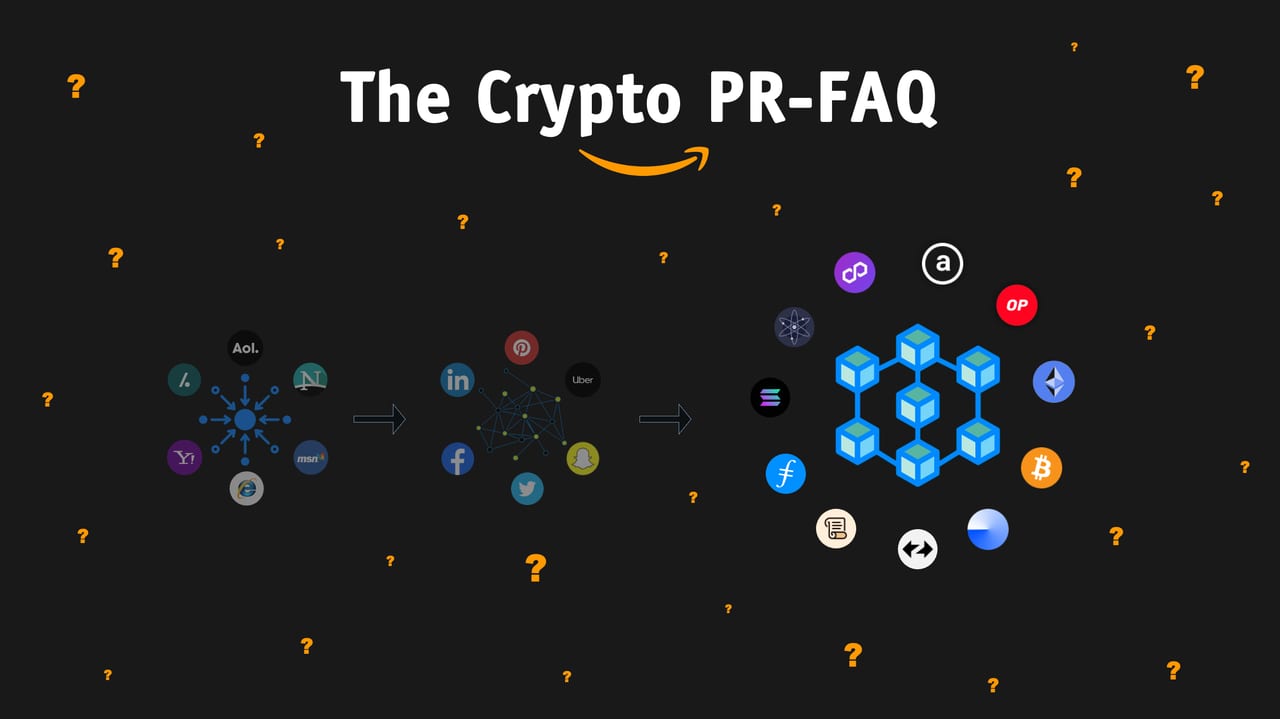
If we’re being candid as an industry: we aren’t offering many compelling answers. This is not because they don’t exist. Rather, the “build it and they will come” ethos that is pervasive amongst many crypto natives assumes that PMF is pre-ordained — and probably why this is true:
crypto conferences have better PMF than almost any crypto product — Chase Chapman (@chaserchapman) July 15, 2023
View tweet
However, I fundamentally believe PMF is something we must pro-actively seek out by first deeply understanding what pain points exist for consumers and then identify how to innovate on their behalf with the capabilities crypto uniquely offers.
To take this more user-centric viewpoint for the industry, I’m using Amazon’s PR-FAQ format (inspired from my days working there). The idea is to craft an aspirational press release of what the future of crypto-powered consumer UX might look like and then work backwards on how we achieve this vision through FAQs. My hope is that this piece serves as a call to arms to focus more on user needs and inspires builders from all walks of life to create delightful user experiences on crypto rails 👊!
Aspirational Press Release
June 3, 2026 (New York Times) - Against the backdrop of skepticism and schadenfreude from its purported demise three years ago, crypto remains alive and well. Today, crypto rails power the “back-end” for many businesses and developers by facilitating improved access to 1) liquidity via DeFi & digital dollars (FKA stablecoins), 2) scarce compute resources such as file storage and GPUs through networks like FileCoin and Render, 3) customer acquisition + retention for brands via multi-touch attribution & digital loyalty programs, and 4) privacy and proof-of-computation technology to secure edge computing via zero-knowledge proofs & fully-homomorphic encryption.
History may not repeat, but it does rhyme. Much like AI, which had prior hype cycles before quietly enabling software companies until its seminal retail flashpoint with ChatGPT, crypto is now having its consumer moment.
ChatGPT-8 and other recently launched crypto-powered AI agents are able to express, match and execute on consumer intent in both guided and autonomous ways. For example via the former, users can request the best burger that delivers within 30 minutes or the best flight to Miami, receive a ranked set of ‘bids’ that match that intent, and have the agent select their preferred option on their behalf. Through the latter, users might fund agents with a specific intent and constraints (e.g. maximize ROI by investing in nuclear energy companies with no more than 20% loss exposure), helping democratize algorithmic trading.
“Crypto rails enable ChatGPT to have ‘write access’ to the Internet by offering the exact combination of attributes needed: a global state machine, permission-less market formation and a natively digital interface for value transfer.”
OpenAI founder Sam Altman (hypothetical)
Another quickly growing crypto-powered consumer app is Squadz, which super-charges the capabilities of micro-communities and boasts over 15MM active users. Squadz enables digital communities to crowdsource resources and collectively own, invest, operate, and govern by providing a legal framework and tools for anti-troll/bot detection via cryptography and AI. Squadz empowers communities at all levels, from local parents and homeowners to form their own micro-schools and homeowner associations to digital communities such as ClimateCrew with 1,200+ members who recently acquired 10,000 acres in the Amazon rainforest to help combat climate change.
“The first era of digital communities (both web2 and web3) revolved around passive actions, such as debating, trolling or speculation. Crypto rails uniquely enable Squadz and our 1M+ communities to take meaningful, collective action by pushing power to the edges.”
Squadz founder Yoo Jiang (hypothetical)
The popularity of these consumer experiences (and others like them) appears to settle a long-standing debate: crypto can uniquely enable experiences which provide users more choice, better value capture and the utility that skeptics previously thought wasn’t possible.
FAQ
Q1: What unmet need(s) do consumers have today?
- Make More $$$— the wealth gap persists (the lowest 50% of earners in the US own 2.4% of the wealth per Statista), despite technology inventing new ways for value creation. Why? B/c the vast majority of users haven’t been able to meaningfully capture this value (yet) thanks to how existing platforms work today and the power law of distribution. As technology continues to dis-intermediate, consumers require better mechanisms to create and capture value, whether it’s earning, owning or speculating.

- Catalyze Change— if you think about how one might enact change today, it’s often by proxy. You might donate money to a cause, vote for someone, complain online, or even organize a rally — but you’re still dependent on a decision-maker to listen and act. This broader feeling of helplessness can often lead to distrust or in-fighting (eg culture wars) that detract from progress. In order to empower people to make change, we need tools to help push power to the edges.
- IncreasedChoice & Convenience — there’s more products, experiences and markets than ever before — but discovery and convenient access have lagged, in part due to the business model and fragmentation of existing marketplaces/aggregators. If there’s anything I learned from my time at Amazon, consumers always want more choice and convenience.
Q2: Why did we list out these unmet needs of users?
Identifying unmet needs allows for a more “first principles” approach to find ground truth of what users actually care about. If you noticed, you won’t find the terms “decentralization”, “permission-less” or “censorship-resistant” mentioned above. It’s not because those things don’t matter or they can’t be important properties of a product — rather, it’s that the vast majority of users simply don’t care.
There will never be a consumer product that takes off purely for political reasons —like “being censorship resistant” or “decentralizing banking”Think of consumers as lizard brains: they mindlessly tap on rectangles on a screen for basic needs —like making money or finding a date — Nikita Bier (@nikitabier) June 12, 2023
View tweet
Q3: How might crypto satisfy these unmet needs for users?
Crypto introduces the following capabilities and mechanisms for humans to interact and coordinate in new ways to help address these unmet needs:
- Permission-less, Bi-directional Value Flow — crypto rails facilitate a simpler and programmable way to send — and perhaps more interestingly, receive — value without requiring permission. At first glance, this may not seem like a big deal — but think how much the Internet changed when users could permissionlessly receive data (email, texts, etc). Enabling an “Internet of value” will generate a tsunami of innovation in how we interact with each other, and new opportunities to create and capture value.
- Resource Formation at Internet Scale — similar to how communication protocols enabled communication at Internet scale, blockchains facilitate the ability to coordinate and pool resources (capital, computational infra, etc) at scale. Projects like SETI@home, which by 2000 was doubling the processing rate of the best supercomputer via decentralized compute power byunpaid volunteers, provide a glimpse of how impactful this can be with structure and economics behind it.
- Intent Markets — blockchains offer a global state machine that is open, credibly-neutral, and composable. In ELI5 terms, it allows consumers to publish intents and have markets coalesce around them. We’ve seen this play out with ERC-20 tokens during the ICO boom in 2017 and NFTs in the last cycle — but have thus far been limited within the confines of the crypto ecosystem. I believe blockchains will enable consumers to publish IRL intents, enable counter-parties who can action to participate in markets that form around this intent (ostensibly offering consumers increased choice + convenience), and both parties to settle trustlessly over crypto rails. (see FAQ #7 for more details).
Q4: Are these capabilities just theoretical?
No, there’s a wide range of crypto-powered examples today which showcase these, ranging from fairly mature to more experimental. On the established end of the spectrum, decentralized finance (DeFi) leverages all three capabilities to process over $100 billion on trades monthly. On the more experimental side, ConstitutionDAO leveraged these capabilities to crowdsource over $40MM in a few days solely based on memes.
If you pop up a level, the true magic of crypto isn’t offering any one of these capabilities in isolation. Rather, crypto allows developers and builders to combine these in ways that uniquely enable new experiences, ways to coordinate, and value capture for users.
Q5: Hmm, these capabilities sound powerful. So why hasn’t crypto found PMF yet?
This is a loaded question, but I believe there are two primary reasons:
- Despite the consensus amongst many in crypto that we’re infrastructure-constrained, the truth is that we’re not (Alok from Standard Crypto does a great job explaining here). We’re nowhere near tapping out TPS or blockspace on any chain — so yes, while we should absolutely continue to invest in infra to make UX better, we need to also be taking many more ambitious shots on goal building consumer applications that marry these capabilities together. Time to get in the lab!
- It turns out that many of the things in the last cycle that were defined as products (wallets, NFTs, DAOs) are actually features. Consumers don’t inherently care about wallets, governance, or other crypto primitives unless they provide real utility besides ‘token go up’. Rather, we need to think about combining these features at the application layer.
Q6: What are some real-world use cases where crypto can offer better experiences for users?
- Increased Utility for AI — we’re in the first inning of what AI agents will look like. Blockchains provide unique infrastructure to make AI agents an order of magnitude more useful via 1) formation of markets to satisfy an agent’s intent, 2) native digital interface for payments + value transfer, and 3) the ability to coordinate with other agents. I envision a world where your personal AI agent can discover the best possible service or product for your intent, earn on your behalf, or become your personalized investment manager (Telegram trading bots are an early version of the latter).
- Creator Monetization — while crypto has tried to fight the notion that its speculative, I think we need to lean into it, especially around empowering creators. Today, creators primarily generate revenue via indirect flows (eg acquire a ton of followers to maximize platform audience, and then figure out how to monetize). One way crypto rails can help creators monetize is giving them the ability to form markets, whether it’s of themselves via social tokens a la friend.tech or their own prediction markets on what matters to their audience. Both of these empower artists & creators to innovate with new forms of value transfer and return real value back to their fans beyond their content.
- Powering Communities & Change — it’s no accident that the era of startup unicorns coincided with the rise of cloud-based SaaS tools. It became easier than ever before for a company of any size to have best in-class hardware, software and communication/productivity tools. In a similar vein, crypto rails will enable communities of any size to enact meaningful change on the specific cause(s) that matter to them by pushing power to the edges. Communities will be able to quickly form, pool together resources, utilize those resources to own, invest or transact, and govern (think Reddit communities on steroids). Furthermore, cryptography via proof of personhood or zero-knowledge verification can protect these communities from spam, bots, and other forms of distraction. These tools can sprout a million seeds of change at the local/micro level (including new tools for activists) that have the potential to deliver far more impact than national or global policies.
- Online Advertising — advertising funds the most popular Internet applications (Google, social media, etc), but real challenges loom. At the top of the funnel, tighter rules on mobile tracking (e.g. IDFA) present headwinds for publishers to effectively target users. In the middle, publishers continue to decentralize with the rise of influencers but affiliate marketing remains inefficient and doesn’t properly reward the full chain of attribution. And the bottom of the funnel remains leaky as users who see or click on an ad a) are often lost forever if they don’t take meaningful action (eg transact, install app, etc) in that session, and b) capture little to no value for their attention. Blockchains can wholly re-imagine this by 1) providing global identifiers (eg wallet addresses) to identify users across applications, 2) implement multi-touch attribution (MTA) to properly incentivize influencers to aid with discovery (companies like Spindl are doing interesting things here), and 3) experiment sending value directly to users that lasts beyond a session (similar to what Brave has tried). Ultimately, robust advertising drives down cost for end users & aids in discovery of superior experiences.
- Governance — if the majority of Americans agree on anything, it’s that we don’t trust our government to act in our best interests. There’s a lot of reasons for this, but one of the primary ones is ineffective or corrupt leadership from our representatives. It doesn’t have to be this way — crypto rails offer a way to push democracy out to the edges and make direct democracy possible by making it simpler for any citizen to vote or delegate their vote. I believe in the next 5 years, we will see examples at the local level (think school board or board of trustees) that is run this way.
Q7: You’ve mentioned the notion of forming markets around intent. Can you expand on that?
Absolutely! Propeller Heads has a fantastic piece about this that I’m going to graciously borrow from. A great way to think about intents is a partial transaction:

This missing piece can be information you don’t have access to, is hard to discover, or don’t have time to find. Blockchains offer a global state where you as a consumer can publish your intent, have markets form that enable counter-parties to compete to be the missing piece, and “settle” the full transaction across all parties. This creates new avenues for discovery, participation by AI agents, dynamic pricing, and coordination such as the “multi-party intent” diagram above where for example, an intent to travel is only satisfied if both flight and hotel needs are met.
An ancillary benefit for counter-parties (eg vendors) of this more “push-style” paradigm is that it provides more cost-effective customer acquisition. Instead of ‘spraying and praying’ your ad spend, you can meet your consumer at the moment they need you.
Q8: What investments are needed to achieve this roadmap?
- More Consumer Experiments — first and foremost, we as an ecosystem need to experiment with more consumer experiences where current UX lags and the capabilities crypto offers can uniquely enable superior experiences. Building infra is cool and we should keep doing it — but not at the expense of waiting for some magical time where blockchains finally scale before building consumer experiences.
- Wallet Abstraction — the vast majority of users don’t understand how to use blockchains or crypto. In line with Vitalik’s vision from EthCC this year, crypto infra needs to make wallet UX as simple as email log-in or Apple Pay. It must be simple to create, recover, deposit assets into, transact, etc (this demo from GoldFinch via native support for iOS passkeys is directionally where we need to head). To do so, we need to further invest in smart contract wallets, account abstraction, more seamless on and off ramps, paymasters to abstract gas, better interop to abstract bridging, and more. L2s such as zkSync or Base are being good stewards here by baking this natively at the protocol layer.
- Mobile — the elephant in the room that few discuss is that for crypto apps to scale, mobile UX has to be significantly better. Regardless of how you feel about friend.tech, its use of progressive web apps (PWAs) shows a way to build mobile experiences that are powerful yet not constrained by the rules of the app stores.
- Vertically-Integrated Infrastructure — the best way to facilitate many of these consumer use cases isn’t to build general purpose infra (e.g. the next L1 or L2). Rather, developers should build vertically-integrated middleware that make it simple for app developers to sit on top of.
- Security— as Nader suggests below, pure self-custody (e.g. not your keys, not your coins) isn’t practical for 99% of users. We need to recognize that and enable hybrid solutions where the default is that centralized custodians play a primary role in security but provides users the autonomy to opt-out if they so choose.
having worked in the blockchain space for ~2.5 years I've formed some unpopular opinions that I'd like to share.1. the problems with security are laughably underestimated by almost everyone here.most people act as if losing your identity and all of your money because you…— nader dabit | nader.lens (@dabit3) June 13, 2023
View tweet
Q9: What are some ideas or apps you’d like to see builders experiment with?
I’ve directionally referenced some areas above, but some specific apps worth trying are:
- Mobile app that offers new dail digital rewards from select brands.
- Prediction Markets App for Creators/Influencers.
- Intent Markets around a specific IRL niche or vertical that is under-served today.
- Consumer App like Squadz referenced in the PR.
- “Direct Democracy” app that makes voting in a community simple and secure.
Q10: What is the most outrageous consumer idea you believe should be experimented with?
If you look back at the history of the Internet, one of the key drivers of its early popularity came from users being able to create websites that others could view on a web browser. Similarly, I think it’s fascinating to explore what the Geocities of crypto would look like. What if building and participating in a protocol, no matter how niche, became an order of a magnitude easier?
Or this:
I would use the LinkedIn version of friend tech. An email inbox that prioritizes messages by $USDC sent to me and I could set a floor price which would guarantee a response. — toly 🇺🇸 (@aeyakovenko) August 21, 2023
View tweet
Q11: What is your biggest pieces of advice for builders who want to utilize crypto?
- The bar to succeed in crypto consumer is low. Pick an area where user experiences sucks today that crypto capabilities can meaningfully make better for users (eg dont blindly build a web3 version of an already successful biz)
- Focus on everyday users, not crypto-native users. Build apps, not dApps 💀.
If you’re building in these spaces or this generally resonated with you, I’d love to hear from you. Reach out to me on Twitter or Telegram!
Thanks first and foremost to my wife Prusha for giving me the time to write this. Also to Mike Zajko, Regan Bozman, Pierre Chuzeville, Kyle Samani, Eshita Nandini, Shawn Dimantha, Vishal Kankani, Shayon Sengupta, Katherine Champagne, Ishika Mukerji, Nick Ducoff, Sanat Kapur, and the many others who provided feedback on this piece.